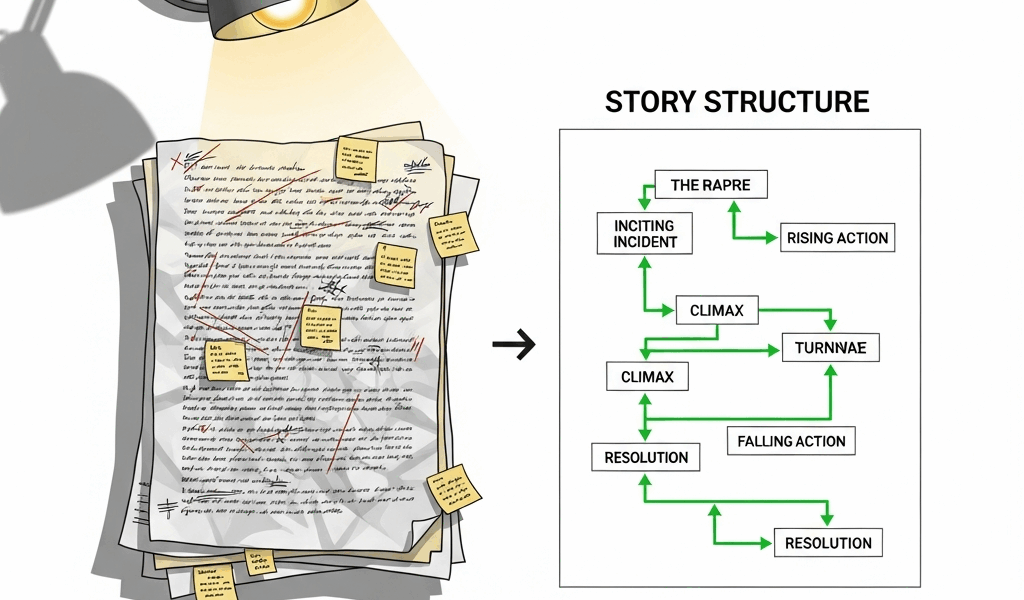
The Real Reason Third Acts Feel Hollow
Third act problems have gotten complicated with all the conflicting advice flying around. Raise the stakes. Cut the resolution. Make the climax bigger. But none of that touches the actual issue — and I learned that the hard way revising a 92,000-word manuscript where the final fifty pages felt like watching someone else’s ending. All mechanics. Zero feeling.
Most writers blame the third act itself. That’s the wrong diagnosis. If your ending collapses, something broke in acts one or two. A motivation wasn’t earned. An obstacle never got properly introduced. A relationship didn’t accumulate enough weight to carry the payoff you’re reaching for. The third act just exposes those gaps — like an X-ray on a bone you didn’t know was fractured.
This isn’t about prose quality. It’s not about dialogue tags or character voice. It’s structural. And structural problems have specific names and specific solutions.
Your Climax Arrives Too Late or Too Early
Climax timing kills more third acts than anything else. Not the climax itself. When it lands.
I’ve read manuscripts where the climax peaks at page 340 of 400. Everything after is denouement — characters catching their breath, loose threads getting tied off, scenes explaining what just happened. Dead zone. Readers feel the story ended forty pages back and wonder why the writer didn’t trust them enough to let it go.
The other direction is worse, honestly. A climax that erupts at the 60 percent mark drains tension from everything that follows. Technically correct. Narratively exhausted.
The benchmark: Your climax should land between 85 and 90 percent of your total page or word count. For a 300-page manuscript, that’s pages 255 to 270. For a 100,000-word novel, somewhere around word 85,000 to 90,000. These aren’t laws — they’re sightlines. They keep the climax close enough to the ending that everything after feels like landing, not coasting.
Before: Sarah confronts the antagonist on page 335 of her 380-page thriller. The reveal lands. The fight happens. The villain falls. Then forty-five pages of recovery scenes — reunion with her daughter, three therapy calls, a visit to her old job, an epilogue set a full year later.
After: Sarah confronts the antagonist at page 320. The reveal, the fight, the fall — all compressed. The next twenty pages move through immediate aftermath: the reunion, one difficult call with the agency that wronged her, a single quiet morning that shows she can breathe again. Done. The story isn’t shorter. It just peaks while momentum is still building instead of after it’s already crested.
Your Protagonist Stops Making Choices
This is what happens when plot takes the wheel. Toward the end of a manuscript — especially after six months in a character’s head — writers slip into a rhythm where things happen to the protagonist instead of the protagonist making things happen.
The antagonist makes a move. Your hero reacts. Another move. Another reaction. Events cascade. The protagonist survives them. Story over. That’s not a third act. That’s a series of obstacles arranged vertically.
A functional third act runs on the protagonist’s decisions. Not reflexes. Not threat-responses. Actual choices that emerge from what they’ve learned or who they’ve become — at least if the preceding two acts did their job.
Before: Marcus gets cornered by the loan shark’s crew. They threaten his sister. He fights them because he has no other option. Security shows up and arrests them. His sister is safe. Relief.
After: Marcus realizes the only exit is a choice the old version of him would never make. He goes to the police first — trades what he knows about the operation for witness protection, choosing his sister’s actual safety over his pride. The crew shows up expecting leverage. They find him already protected. He wins not by throwing punches but by deciding differently than he ever has before.
That’s agency. In the before version, Marcus is a billiard ball. In the after, he’s the one holding the cue.
The Emotional Payoff Does Not Match the Setup
Probably should have opened with this section, honestly. Because this is where stories die quietly while looking completely polished from the outside.
Act one makes emotional promises. Not explicit ones — implied ones. A scene where your protagonist mentions she hasn’t spoken to her estranged mother in seven years? The reader’s brain flags it: this will matter later. A subplot where your character loses a job he loved and starts doubting his own competence? That’s a debt. A friendship fractured by betrayal? That’s a wound. Wounds need healing or explaining. Debts need paying.
Your third act must pay them. Not mention them in passing. Not resolve them through some convenient coincidence that saves you from doing the actual dramatic work.
I once wrote a scene — and I’m not proud of this — where my protagonist’s estranged mother appeared unexpectedly at the climax and everything resolved. Neat. Clean. Completely unearned. The character hadn’t done a single thing to bridge that seven-year gap. She hadn’t risked the confrontation, hadn’t shown any vulnerability, hadn’t even tried. Mom just showed up because I needed the emotional beat and didn’t want to earn it. Don’t make my mistake.
The fix: open chapter one. Make a list — every emotional setup, every relationship wound, every piece of unfinished business your character is carrying. Write them down somewhere you can see them. Then open your third act and check: does at least one scene or conversation specifically address each item? Not vaguely. Specifically.
If the mother subplot exists, your character needs a moment in act three where they actively choose to mend it, acknowledge why they can’t, or consciously decide to leave it broken. That choice belongs to your protagonist. Not to mom showing up uninvited. Not to circumstance doing the heavy lifting for you.
A Fast Checklist to Diagnose Your Third Act
Run through this now, while the manuscript is still open.
- Does your protagonist make the final decision that directly causes the central conflict to resolve? (Not: something happens to them. But: they choose something that matters.)
- Does your climax land between 85 and 90 percent of total word count or page count? (Measure it. Don’t guess — guessing is how you end up forty pages past the peak.)
- Is there a scene in act three where your protagonist actively addresses at least one emotional setup from act one? (The mother. The old wound. The fractured friendship. Something with actual teeth.)
- Do all major subplots reach a clear state — resolved, abandoned, or deliberately transformed? (Hanging threads read as mistakes, not mysteries.)
- Could you cut the final chapter entirely and the story would still feel complete? (If yes, your climax peaked too early. Full stop.)
- Does your protagonist have a moment where they act on what they’ve learned — not just what they’ve endured? (Growth expressed through choice. Always.)
Three or more no answers and your third act isn’t broken — it’s incomplete. Incompleteness is fixable. Start with the climax timing. Find your 85 percent mark and move the peak there. Then work backward: what decisions need to happen before that moment for it to land with any weight? Which emotional debts are still unpaid? Which subplot threads are still dangling somewhere around chapter fourteen?
Your third act didn’t fail because you lack talent. Something earlier didn’t prepare it to succeed — and that something has a specific address. Find it. Fix it. The rest usually follows on its own.




Stay in the loop
Get the latest the writers workshop updates delivered to your inbox.