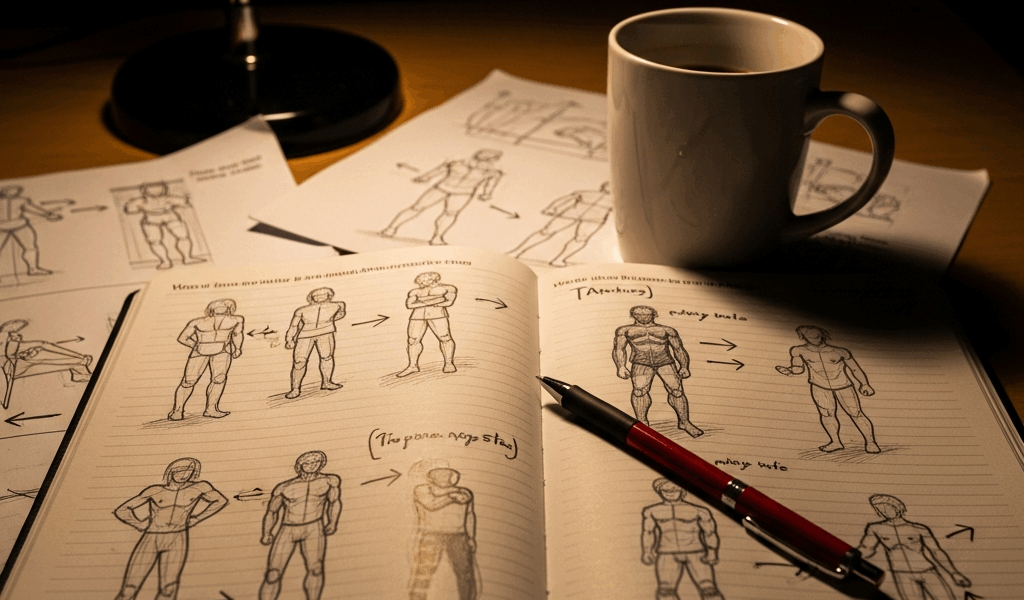
How to Write Fight Scenes That Feel Real and Tense
Fight scenes have gotten complicated with all the conflicting advice flying around. After eight years workshopping novels with writers, I’ve learned to spot a failing fight scene within three sentences. Not because the combat is unrealistic—I don’t care if someone throws a left hook wrong. I spot it because the reader stops holding their breath. The tension just vanishes. And usually, it’s for one of two reasons: the writer got so caught up in choreography accuracy that the scene reads like a martial arts manual, or they leaned so hard into emotion that the reader has no idea where the characters’ bodies actually are in space.
But what is a good fight scene? In essence, it’s a sequence where readers feel genuinely afraid. But it’s much more than that. It requires understanding how narrative tension works when bodies collide—and honestly, it’s not about mastering punch combinations at all.
Why Most Fight Scenes Fall Flat
The trap is deceptively simple. Writers believe realism lives in technical accuracy. They research boxing stances. They memorize judo throws. They write sentences like: She pivoted left, driving her elbow toward his ribs while simultaneously checking his counterattack with her forearm.
Readers don’t care. Not really.
What happens instead—the scene becomes a list. Move, move, move, move, punch, dodge, move. The pacing flattens into an itemized catalog, and somewhere around the fifth described movement, the reader’s amygdala goes quiet. The fight stops feeling dangerous because it stops feeling *present*. It feels choreographed, which, technically, it is, but the reader shouldn’t feel that seam.
The opposite trap destroys just as effectively. Writers abandon spatial logic entirely and write pure sensation: Fury exploded through her chest. His fist came. Pain. Rage. The world tilted.
Now the reader feels the emotion, sure. But they don’t know if she’s on her back or her feet. They can’t picture the fight. And without a clear sense of spatial stakes—without knowing that if she falls here there’s a concrete pillar behind her—the emotional reaction has nowhere to land. Fear needs specificity to survive.
The real tension in a fight scene lives in the space between these two poles: enough choreography that the reader can track what’s happening, enough sensory pressure that they *feel* what’s happening.
Ground Your Action in One POV Character’s Experience
Probably should have opened with this section, honestly.
Most weak fight scenes suffer from omniscient camera syndrome. The writer pulls back, takes a bird’s-eye view, and describes the entire fight as if they’re watching it on film. She lunged. He sidestepped. His hand came up toward her throat. Neutral. Distant. Safe.
Real combat doesn’t feel that way to the person experiencing it. It’s claustrophobic. Your vision narrows. You don’t see what’s happening on your opponent’s left side—you’re not looking there, so the reader shouldn’t know it either. You feel the hit before you consciously understand it was coming.
Tight POV forces you to stay inside your fighter’s sensory world. They only know what they can perceive in real time. This immediately creates narrative tension because your character’s knowledge is limited, and readers feel that limitation as danger.
Here’s the difference. Loose POV: She threw a jab. He rolled under it and brought an uppercut toward her jaw, but she’d already begun her pivot, using his momentum to drive him past her toward the wall.
Tight POV: She shot her fist forward and felt it cut air—he was already moving. Then his shoulder rose beneath her vision and she twisted hard, letting his forward weight carry him past her ribs. The wall behind him seemed to jump closer.
Same action. Same outcome. But the second version puts the reader inside her body. She doesn’t see his uppercut coming—she responds to it reactively, and the reader learns about it at the exact moment she does. The reader discovers the wall with her. They’re trapped in her perspective, which means they’re trapped in her danger.
Sustaining tight POV throughout a fight is harder than it sounds. You’ll want to slip into omniscience to explain what your opponent is thinking or planning. Don’t. If your character doesn’t know, the reader doesn’t get to know. That mystery is your tension.
Use Sensory Detail to Replace Choreography
You won’t need to choreograph a fight scene like you’re directing a film. You will need to write it like you’re documenting a person’s experience of threat.
This is where technical accuracy becomes irrelevant. A boxer might throw a jab-cross-hook combination. A reader doesn’t care about the sequence. They care about what it *feels* like to be on the receiving end — impact, pressure, disorientation, pain.
When I revised my own fight scene last year, I cut 60% of the technical description and added sensory specificity instead. My character was in a knife fight—previously, I’d written about his grip, his footwork, his angle of attack. I deleted almost all of it. Instead, I wrote: His palm slicked with blood. The grip shifted. Cold air rushed where the knife had been. Three sentences. Suddenly, the reader *knew* the danger. They felt the variable stakes—the slipping grip meant uncertain control, and that’s what creates tension.
Breath is underrated in fight scenes. He came at her and she gasped, her lungs tight. Two words—”gasped,” “tight”—and the reader feels panic. Disorientation works similarly. The blow came from somewhere and the world tilted sideways. Your character doesn’t know where the hit originated. Neither does the reader. That shared confusion is terrifying.
Fatigue breaks tension apart if you’re not careful, but use it right and it *extends* tension. Her arms were lead now, and his hand came again—she couldn’t raise her guard fast enough. That’s the moment readers stop breathing. Not because of the choreography, but because her body is failing her.
Control Pacing Through Sentence Structure and Rhythm
Sentence length is your pacing tool. Use it.
Short sentences accelerate tempo. He hit her. She fell. But she’d already moved to make the fall controlled, rolling with it, coming up on her knees. The staccato rhythm mirrors quick, explosive action. The reader’s eye moves fast down the page and their heart rate jumps.
Longer sentences slow things down or create pressure. The moment stretched as his fist approached and she understood with absolute clarity that she couldn’t move fast enough, that everything was happening at the speed of inevitability, that the impact was already a fact. The sentence sprawls. The reader moves through it slowly. Time seems to dilate. This is the moment before the hit lands—not confusion or speed, but a weird, terrifying slowness.
Here’s a passage where sentence structure does real work:
He came at her again. Fast. She raised her guard, felt the impact shudder through her arms, and then he was already moving, circling, and she knew—with the kind of knowledge that doesn’t travel through thought—that he was faster. The next punch came from the side, low, and she was too slow, way too slow, and it landed in her ribs and the world compressed to just pain and the absolute need to breathe.
Notice the rhythm: short shot, medium setup, long stretch of pressure, then short sharp impacts. The sentences mirror the action’s acceleration and weight. This is the opposite of uniform pacing. Read it aloud and you’ll hear how the sentence rhythm actually *sounds* like combat.
End the Scene With Emotional Consequence, Not Just Victory
A fight scene isn’t done when someone falls. Too many writers treat combat like a contained action sequence—character A fights character B, character A wins, scene ends. But fight scenes are never just about the fight. They’re about what the fight *does* to the character’s understanding of their situation.
The worst mistake I see is writers ending on triumph. She landed the final blow and he went down. Victory. Flat. Empty. Why should the reader care?
Real fights change something. Maybe she thought she couldn’t win and now she knows she can—but that knowledge terrifies her because it means she’s capable of something she didn’t think she was. Maybe he lost and now the entire power structure of the story has shifted and he’s spiraling. Maybe they both survived and now they’re bound by a different kind of understanding.
The scene ends *emotionally*, not physically. The physical victory is just information. The emotional consequence is the story.
Your character is still breathing hard. Maybe their vision is still swimming. They look down at their hands and don’t recognize them. They think about what comes next, and the reality of it hits different now because they’ve just been reminded that their body can fail them, that pain is real, that they are actually mortal.
That’s where you end. Not on the knockout. On what the fight *changed*.




Stay in the loop
Get the latest the writers workshop updates delivered to your inbox.