Why Telling Stops Readers Cold
The moment a reader encounters telling instead of showing in your novel, something breaks. Not catastrophically at first—more like a hairline fracture in trust. I learned this the hard way when my agent sent back my manuscript with a single note scrawled on page 47: “She was angry. Show me.”
Three words. Forty-seven pages in. I wanted to argue that the context made it obvious. Instead, I read those three words again and felt exactly what my reader would feel: nothing. No racing heartbeat, no clenched fist, no sharp intake of breath. Just the author telling me what to think.
Here’s the difference: When you write “She felt devastated,” you’re summarizing an emotion from the outside. The reader receives information like a Wikipedia entry. When you write “She stared at the letter for three minutes without blinking, then set it on the table and walked to the kitchen to pour coffee she didn’t want,” the reader experiences the devastation through physical details. They live it instead of being told about it.
Telling creates distance. Showing creates presence. That’s not poetic—it’s neurological. The reader’s brain activates sensory regions when processing concrete details, not abstract emotional labels. You’re not just describing sadness; you’re triggering the neural pathways that recognize sadness.
The Three Types of Telling That Kill Momentum
Before you can fix telling, you need to recognize which category you’re guilty of. Most writers aren’t adding vague emotional declarations randomly. They’re making one of three specific mistakes.
Type 1 — Emotional Telling
This is the most common and easiest to spot. It happens when you name an emotion directly instead of showing its physical expression.
Bad example: “Marcus was terrified of disappointing his father.”
What you’re actually telling the reader: an abstract fact about a character’s psychology. Readers don’t feel it. They process it like a bullet point in a character worksheet.
Another one: “She loved him desperately.” This appears in more manuscripts than any other telling sentence I’ve encountered. Desperately is doing all the work here, and readers skip right past it because they’re numb to these constructions. They’ve seen it a hundred times before.
Type 2 — Backstory Dumps
This usually masquerades as exposition. You’re providing necessary information, so it feels legitimate. It’s not.
Example: “James had lost his mother at sixteen, which made him protective of anyone vulnerable. This stemmed from his inability to protect her from cancer.”
You’ve just handed the reader three pieces of information in summary form. Instead of witnessing James’s protectiveness through action or dialogue in a scene, readers get the explanation. The difference matters because experience teaches; summary informs.
Backstory dumps usually appear when you panic about whether readers understand motivation. Probably should have opened with this section, honestly—I used to do this constantly. I’d explain character psychology rather than reveal it through behavior. I’d spend entire paragraphs justifying why someone acted a certain way instead of letting the reader figure it out from what they saw.
Type 3 — Author Intrusion and Narrator Summary
This is when your narrative voice steps out of the story to comment on what’s happening. It’s often subtle, which makes it dangerous.
Example: “The conversation that followed would change everything. David didn’t know it yet, but this was the moment his marriage ended.”
You’re not showing the conversation; you’re narrating about it. You’re telling readers what to think about its significance before they’ve experienced it.
The Sensory Replacement Technique
Fix telling with this process. It works across every genre.
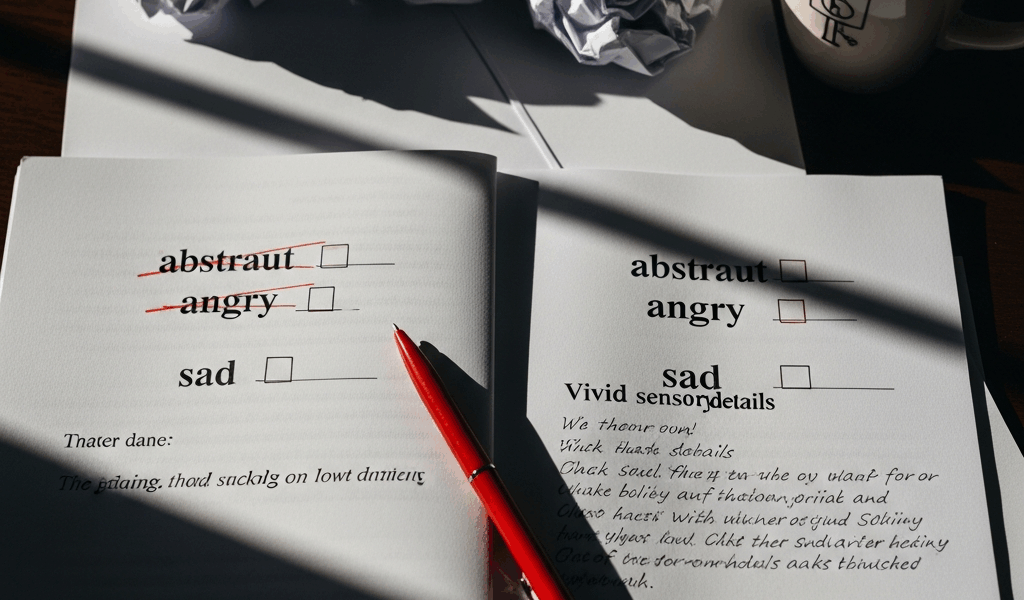
Step 1: Identify the told sentence. Search your manuscript for emotional labels, summary statements, or author commentary. Circle them. Print them out if you need to.
Step 2: Name the underlying situation and emotion. What is actually happening? What does the character actually feel?
Step 3: Replace with sensory detail, action, or dialogue that reveals the emotion.
Here are real before/after examples:
Literary Fiction Example
Before: “Elena was devastated by the letter. She had always hoped her father would forgive her.”
After: “Elena’s hands shook as she held the envelope. Not from cold. From the fact that it contained a forwarding address—nothing more. No salutation, no signature. Her father’s handwriting had aged; the letters tilted right, as if the pen itself had given up.”
Notice the shift. You’re no longer being told she’s devastated. You’re watching her hands betray her emotion. The physical detail of aging handwriting becomes a revelation about time, distance, and rejection without a single emotional label.
Thriller Example
Before: “Marcus was terrified as he approached the warehouse. He knew the men inside would kill him if they found out he’d been skimming.”
After: “Marcus kept his hand near the Glock as he pushed through the warehouse door. His shirt was damp. Not from sweat—from the fountain in the parking lot where he’d splashed his face before coming in. He needed to look calm. He needed his collar to stay pristine and his smile ready. One bead of sweat and Volkov would notice.”
The physical actions—touching the gun, splashing water, maintaining composure—demonstrate the terror far more effectively than the word itself. You’re showing survival instinct rather than stating fear.
Romance Example
Before: “Claire loved him so much it hurt. She had never felt this way before.”
After: “When James’s hand found hers across the table, Claire forgot the script she’d practiced. Forgot the careful distance she’d maintained. Her thumb brushed his knuckle once—intentional—and she watched his pupils dilate. Just that small touch shifted something. She could breathe again. Or maybe she’d stopped breathing and that was the point.”
Physical touch, behavioral response, the internal sensation of breathing—these convey intensity better than “so much it hurt” ever could.
When Telling Is Actually Okay
Not every sentence needs to be shown. This matters. If you try to show everything, your pacing collapses and readers exhaust themselves.
Light telling works for narrative summary between scenes. “James spent the next three weeks avoiding Maria” is fine if nothing important happens during those three weeks. You’re not avoiding showing a crucial moment; you’re moving time forward efficiently.
Transitions benefit from telling. “The conversation moved to politics, where it always grew heated” gets readers from one important scene to the next without waste.
Time skips require telling. “Ten years passed” is faster and more honest than pretending you could show a decade in vivid scenes.
The rule: If it’s crucial to your reader’s emotional engagement, show it. If it’s necessary information but not emotionally important, tell it efficiently and move on.
Your Revision Checklist for This Week
Use this checklist to identify telling in your manuscript. Search for these patterns, then decide if each one requires revision:
- “She felt [emotion]” or “He was [emotion]”—Replace with physical sensation or action
- “It was [emotion]-adjective” (heartbreaking, terrifying, beautiful)—Replace with specific sensory details
- “This made her [action/emotion]”—Replace with direct scene showing the consequence
- “He had always [backstory fact]”—Replace with brief scene or action that reveals it
- “The [event] meant [interpretation]”—Replace with showing characters responding to the event
- “She loved him because [reason]”—Replace with actions and moments that demonstrate love
Start with just these six patterns. You’ll catch probably 70% of your telling problems. Copy this list into your editor’s find function and work through systematically.
The fix isn’t about following rules. It’s about trusting readers to understand what they witness. When you show instead of tell, you’re saying “I believe you’re intelligent enough to feel this yourself.” Readers respond to that trust by caring more deeply about your characters.




Stay in the loop
Get the latest the writers workshop updates delivered to your inbox.