The Decision Every Self-Published Author Faces
KDP Select vs wide distribution has gotten complicated with all the conflicting noise flying around. As someone who spent eighteen months bouncing between both strategies — hemorrhaging money in one direction or the other the entire time — I learned everything there is to know about this particular headache. Today, I will share it all with you.
This article includes affiliate links. We may earn a commission at no extra cost to you.
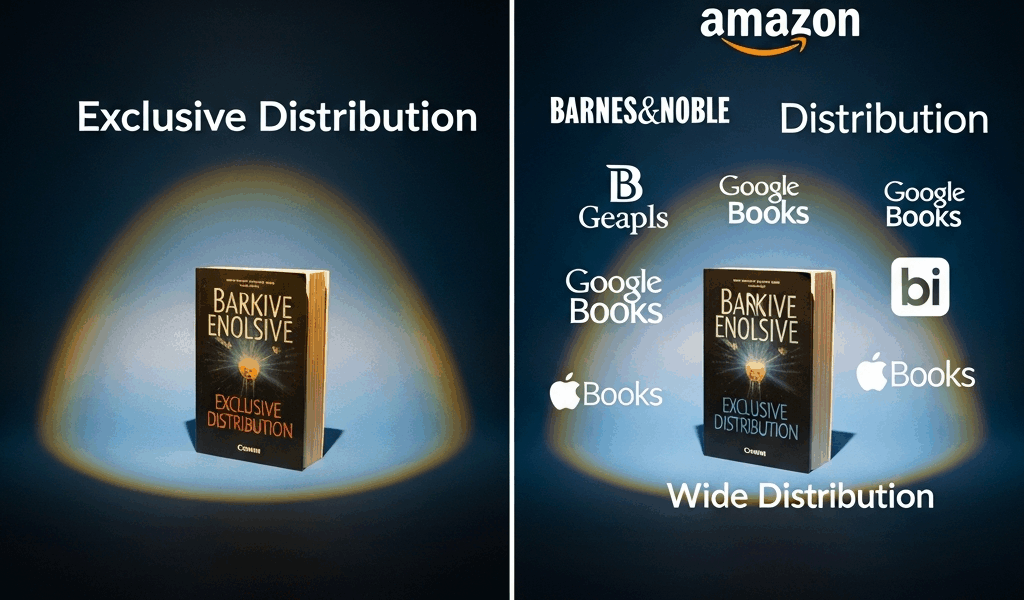
But what is the core issue here? In essence, it’s this: KDP Select hands Amazon a 90-day exclusive on your ebook. Nobody else sells it during that window. Wide distribution means your book lives simultaneously on Apple Books, Kobo, Google Play, Barnes & Noble — anywhere that’ll have it, no restrictions. But it’s much more than that simple distinction, and the difference in outcomes depending on your genre can be staggering.
Both choices work. Neither is universally right. The conditions under which each one works are specific — and most advice you’ll find online glosses right over those conditions. This piece doesn’t.
KDP Select — What You Get and What You Give Up
Frustrated by a total lack of clear guidance, I enrolled my first short fiction collection into KDP Select without fully understanding what I’d agreed to. The 90-day exclusive term auto-renews unless you manually opt out — 72 hours before the renewal date, not the last day, which is the kind of buried detail that costs people real money. It cost me six months on two titles I can’t get back.
So what are you actually getting?
Kindle Unlimited Access
Kindle Unlimited is Amazon’s subscription reading service — $9.99 per month for readers. Subscribers read any enrolled title for free. You earn based on pages read, not borrows. Amazon calculates this through the Kindle Edition Normalized Page Count (KENPC), and the payout rate shifts monthly based on the total KU Global Fund divided by all pages read across the program.
Recent KENPC rates have hovered around $0.0045 to $0.0047 per page. A 300-page novel generates roughly $1.35 to $1.41 per full read-through. Compare that against a $2.99 ebook sale at 70% royalty, which nets $2.09. If readers are completing your book regularly, KU is competitive. If they’re abandoning it at 40%, you’re clearing about $0.55 per borrow. The math matters enormously — probably more than anything else in this decision.
Promotional Tools
KDP Select unlocks Kindle Countdown Deals and Free Book Promotions. Countdown Deals let you run a time-limited price reduction while keeping the 70% royalty active. Drop to $0.99 and you still earn roughly $0.70 instead of the standard $0.35 you’d earn at that price point outside the promotion. Free Book Promotions give you up to five days per 90-day enrollment period to offer your book at no cost — drives download volume, spikes your rank.
These tools work best with a backlist. One free book in a series pulls readers into buying the rest. A single standalone title on a free promotion is essentially a giveaway with limited downstream revenue. That’s the honest version of it.
What You Surrender
Every platform that isn’t Amazon. Apple Books operates across 170 countries and moves serious revenue in Germany, Australia, and Canada. Kobo dominates the Canadian market — authors are consistently surprised by those numbers — and carries significant reach in Japan through the Rakuten partnership. Google Play Books is quietly enormous in markets where Android penetration runs high, including large parts of Southeast Asia and Latin America.
While you’re in KDP Select, none of that revenue exists for you. Not reduced. Absent entirely. For authors with international appeal or genre audiences that skew toward Apple device users, that’s a genuine, measurable cost.
Going Wide — The Long Game
Wide distribution is slower. That’s the honest thing to say first, so let’s say it. Building readership across multiple platforms simultaneously — without the algorithmic boost Amazon gives KU-enrolled books — takes longer. Most wide authors will tell you the first six months feel like shouting into a void. I’m apparently stubborn enough to have pushed through it, and Kobo’s Canada revenue eventually worked for me while Amazon exclusivity never quite did for that particular set of titles.
But the ceiling is different.
Platform Diversity as Risk Management
Amazon’s algorithms change. KU payout rates change. Terms of service shift. Authors have had accounts terminated with minimal explanation and no meaningful recourse. When your entire income depends on one platform’s goodwill, that’s not a business — it’s a fragile arrangement dressed up as one.
Wide authors spread that risk across multiple surfaces. An Apple Books algorithm change hits one slice of revenue. A Kobo promotional feature drives unexpected sales in a given month. Google Play serves reader segments that never touch Kindle. The diversification isn’t just philosophical — it has practical income-smoothing effects that compound over time.
Platforms Where Wide Authors Thrive
- Apple Books — Strong in non-fiction, self-help, and literary fiction. Apple readers skew slightly older, tend to have higher disposable income, and average transaction values on Apple Books are often higher than Amazon for the same titles.
- Kobo Writing Life — Excellent for romance, mystery, and thriller authors. Their Plus subscription service is growing and creates a KU-like read-through income stream — without exclusivity. That’s what makes Kobo endearing to us wide-distribution advocates.
- Google Play Books — Underutilized and under-discussed. Particularly strong in markets where Android dominates. Non-fiction and how-to content performs well here specifically.
- Barnes & Noble Press — Declining but not irrelevant. Romance and cozy mystery still move through Nook, particularly with older US readers. Don’t write it off entirely.
The Aggregator Question
Probably should have opened with this section, honestly, because the logistics of going wide trip up authors before the revenue question even becomes relevant. Most wide authors distribute through an aggregator — Draft2Digital (which now incorporates Smashwords) or PublishDrive — rather than uploading manually to every platform. Draft2Digital charges no upfront fee but takes 10% of royalties from sales on platforms where they distribute. Direct upload to Apple Books and Kobo gives you 100% of the listed royalty rate, but requires managing multiple dashboards simultaneously. So, without further ado, let’s dive into how the revenue actually breaks down by genre — because that’s where this decision really gets made.
Revenue Comparison by Genre
Genre is the single most important variable here. More important than your backlist size, your marketing budget, your publishing timeline — more important than almost anything else.
Genres Where KDP Select Wins
Romance is the clearest example. Kindle Unlimited was essentially built around voracious romance readers, and the numbers confirm it. A romance author with a ten-book series enrolled in KU generates substantial page-read income from readers who consume three or four books per week — readers who won’t pay $4.99 per title but will absolutely read them all on a $9.99 monthly subscription. Some mid-list romance authors report 70–80% of total revenue coming from KU page reads rather than direct sales. That was a genuinely surprising figure the first time I encountered it.
Cozy mystery, paranormal romance, and LitRPG follow similar patterns. High-volume, series-driven genres with dedicated KU subscriber bases — that’s where Select earns its keep.
Scenario: A romance author with a five-book series, each book 80,000 words — roughly 320 KENPC pages. At $0.0046 per page, a full read-through earns approximately $1.47. If 1,000 readers complete each book per month across the series, that’s $7,350 monthly from page reads alone, plus direct sales from non-KU buyers. That’s a real business built on one distribution decision.
Genres Where Wide Wins
Non-fiction performs markedly better wide — business, health, and self-help titles especially. These readers buy directly, skip KU entirely, and are more likely to be Apple or Google ecosystem users. A $14.99 business book moving 50 copies per month on Apple Books at 70% generates $524.65. That revenue simply doesn’t exist if the book is locked into Amazon exclusivity. Don’t make my mistake of assuming Amazon is the whole market for every type of book.
Literary fiction is another case. KU subscribers read quickly and in volume — literary fiction readers are slower, more deliberate, and less likely to be KU subscribers at all. They buy. Wide platforms suit that purchasing behavior significantly better.
Scenario: A literary fiction standalone priced at $7.99. On Amazon outside KU, 30 sales per month at 70% royalty generates $167.79. The same book on Apple Books adds another $167.79. Kobo adds 20 sales: $111.86. Google Play, 15 more sales: $83.93. Total monthly across four platforms: $531.37. That same book enrolled in KDP Select, with lower literary fiction completion rates dragging KU page-read income down to roughly $90–120 per month on average — the difference is not subtle.
The Hybrid Reality
Some authors keep fast-moving series titles in KDP Select while publishing non-fiction or standalone literary work wide. This isn’t fence-sitting. It’s matching distribution strategy to reader behavior by genre — which is the actual skill in all of this. Amazon doesn’t prohibit it. Different titles can run under different distribution arrangements simultaneously.
The Verdict — Start Exclusive, Go Wide Later
Here’s the position I’ll defend: most debut authors in commercial fiction genres should start in KDP Select. Not forever. Not even necessarily for the second book. For the first 90 days of a novel’s life, KU enrollment provides algorithmic visibility and promotional tools that a new author with no existing audience cannot replicate through wide distribution alone.
New KU releases get surfaced to subscribers in recommendation feeds. Borrow counts signal traction to Amazon’s ranking system. A debut author going wide on day one splits whatever marketing energy they have across five platforms simultaneously — zero existing readership on any of them — and typically gets buried on all of them. I’ve watched this happen repeatedly. The visibility argument for starting in Select is real, at least if you’re writing commercial genre fiction with no established platform.
The mistake I made was staying in KDP Select past the point where it was serving me. My second and third books auto-renewed because I missed the 72-hour opt-out window before the term ended. Six months gone on those titles. Learn from that rather than repeating it.
When to Make the Switch
Move wide when at least one of these conditions is true:
- You have a backlist of three or more titles and a reader list built independently of Amazon
- You’re writing in a genre where KU saturation is working against you — too many similar titles competing for the same page-read pool
- Your non-US sales are significant or your subject matter has natural international appeal
- You’re writing non-fiction, literary fiction, or any category where buyers — not subscribers — are your core audience
- You want a publishing business that doesn’t depend on a single company’s goodwill for its survival
The wide transition takes time. Expect three to six months before meaningful traction appears on new platforms. This is not a failure of the strategy — it’s the nature of building fresh algorithmic history on each new platform from zero. Authors who abandon wide after two months and report that “it doesn’t work” didn’t give it enough runway, and they usually didn’t market into the specific platforms they were entering either.
One More Thing Worth Saying
The authors most vocal about KDP Select being the only viable strategy tend to be romance authors with large KU-optimized backlists. The authors most vocal about wide being the only real path tend to be non-fiction writers or literary novelists who built audiences before Amazon became the center of everything. Both groups are reporting accurately from their own experience. That’s what makes this debate so endlessly circular to us indie author types — nobody is lying, they’re just generalizing from a specific situation that may not be yours.
Your genre, your release cadence, your existing platform, your target reader — these determine which distribution model actually serves you. The data points toward Select for romance and toward wide for business books. Matching the strategy to the reality of your specific situation is the actual skill here.
Start where you can be found. Build enough of an audience that you have real options. Then make the distribution decision from a position of information rather than assumption. That sequence has worked for enough authors across enough genres that it’s the closest thing to reliable advice this industry actually offers.




Stay in the loop
Get the latest the writers workshop updates delivered to your inbox.